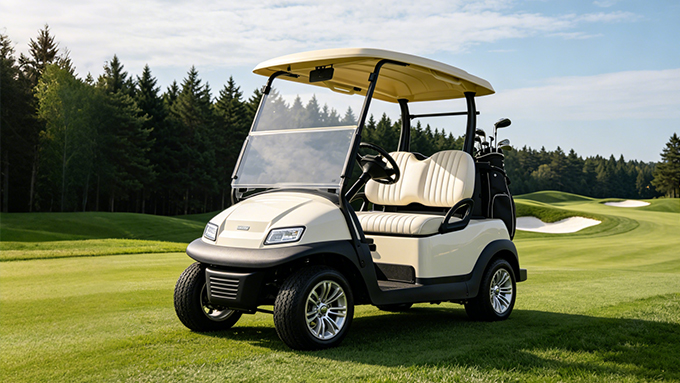
Golf carts and sightseeing vehicles are widely used in golf courses, hotels, resorts, airports, factories and other venues. As their core power source, batteries directly determine driving range, performance, service life and operating costs. With batteries available in various brands, capacities and cell materials, how do you select the most suitable battery for your golf cart? This guide provides a comprehensive, multi-faceted analysis of golf cart batteries.

What types of batteries are used in golf carts?
Lead-acid and lithium-ion batteries can satisfy nearly all operational demands of golf carts, and you should select the appropriate battery type based on actual application scenarios. Modern batteries for golf carts fall into two major categories: lead-acid batteries (flooded / AGM / gel cell) and lithium iron phosphate batteries. Each variant has distinct advantages and disadvantages in terms of cost, weight, charging speed and maintenance requirements. Service life and usage scenarios should be prioritized when making your selection.
How to Choose the Right Electric Golf Cart Batteries for Your Business?
Battery Voltage and Battery Pack Configuration
Commercial vehicle fleets require unified voltage standards to prevent component mismatches. The core configurations are listed below:
36V System: Only applicable to compact golf carts and sightseeing vehicles.
48V System: The mainstream commercial system (ideal for golf courses, resorts and logistics centers). Recommended configurations:
AGM Batteries: 6 units of 8V/200–225Ah connected in series (20–30 miles of driving range per full charge).
Lithium Iron Phosphate Batteries: 48V/100–200Ah (30–50 miles per charge; 150–200Ah for heavy-load applications).
60V/72V System: For premium heavy-duty logistics vehicles or golf courses with hilly terrain, opt for 60V/72V 100–200Ah LiFePO4 batteries.
Battery Size and Capacity
Select the appropriate Ampere-hour (Ah) capacity based on your demands, followed by matching voltage and battery dimensions. Driving range is determined by the Ah rating of golf cart batteries, while the size of the battery compartment limits the maximum installable battery dimensions. When wiring battery packs in parallel, use short cables of identical length. Refer to the golf cart battery dimension chart to avoid mismatched batteries, and observe weight limits (in pounds) to protect the battery compartment.
Selection Based on Application Scenarios
High-Intensity Golf Courses
Capacity: Choose high-range models compatible with fast midday charging.
Discharge Performance: High continuous discharge rate (1C or above recommended) to sustain consistent hill climbing.
Heat Dissipation: Prioritize active air cooling systems for prolonged high-temperature operation in summer.
Monitoring: Fleet-level cloud platforms are essential for real-time tracking of battery state of charge and health of every vehicle, supporting optimized scheduling.
Recommendation: 36V, 48V, 60V and 72V lithium iron phosphate battery systems are all suitable.
Rationale: Excellent stability, long service life and ample driving range.
Large Resorts & Tourist Attractions
Compatibility: Prioritize plug-and-play compatibility with a wide range of older vehicle models.
Safety: Emphasize reliable Battery Management System (BMS) and high waterproof rating (IP67 recommended) to withstand all harsh weather conditions.
Management: Intelligent monitoring platforms optimize travel routes and charging schedules.
Recommendation: 48V, 60V, 72V lithium iron phosphate battery systems.
Rationale: Outstanding fast-charging performance amid frequent stop-and-go operation.
Industrial Parks & Airport Patrol Vehicles
Durability: Battery housings must be robust and shock-resistant.
Charging Speed: Support high-power fast charging for top-ups during shift breaks.
Cycle Life: Cycle life performance under high temperatures is critical given heavy daily usage.
Recommendation: 60V/72V lithium iron phosphate battery systems.
Advantages: Lightweight, long cycle life and reliable all-weather performance.